You don’t need a cellar to look after your wine. Whether you’ve stocked up for Christmas or you’re keeping a special bottle for an anniversary, a few simple rules will keep it tasting its best. Here’s how to store wine at home: the right temperature, the best spots in the house and what to buy if you need a little help.
This article contains affiliate links, so Wine Lees may earn a small commission if you buy through them, at no extra cost to you. All our recommendations are chosen independently. Find out more.
What’s the best way to store wine?
A few simple rules will keep almost any bottle in good shape:
- Keep it cool: ideally around 13°C, and below 18°C
- Keep it steady: avoid big swings between day and night or summer and winter
- Keep it dark: away from sunlight and bright lights
- Keep it on its side: if the bottle has a natural cork
- Keep it still: away from vibrating appliances, which can disturb the sediment in older bottles
What temperature should you store wine at?
The ideal temperature for storing wine is around 13°C, but anywhere between about 7°C and 18°C is fine for a few months. Above 20°C, wine starts to age too quickly, and real heat can cook it, leaving it flat and jammy.
Stability matters even more than the exact number. A cupboard that stays at 16°C all year is better than a room that swings between 10°C and 22°C. Not sure about a spot? Leave a thermometer and hygrometer there for a few days and check it at different times of day.
Don’t confuse storage temperature with serving temperature: you’ll often chill whites and sparkling wines further, or let reds warm up slightly, just before opening.
Should wine bottles be stored lying down?
Bottles with a natural cork
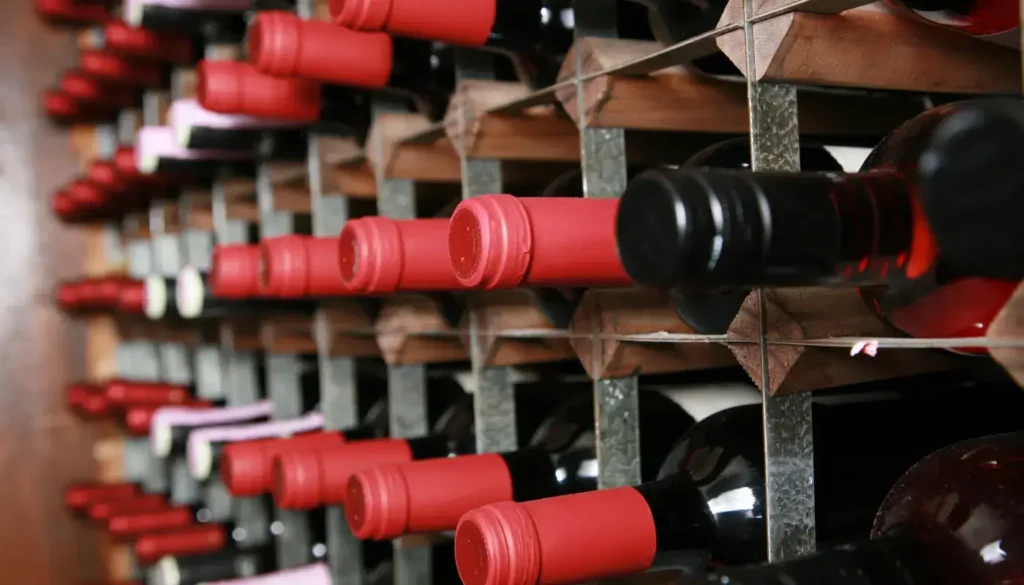
Yes, if you plan to keep them for more than a few months. Lying the bottle on its side keeps the wine in contact with the cork, which stops it drying out, shrinking and letting air in. For bottles you’ll open within a few weeks, standing them up is fine.
A simple stackable wine rack is the easiest way to keep bottles on their side, and it saves space too.
Screw caps and fortified wines
Bottles with screw caps or synthetic corks don’t need to lie down, as the closure can’t dry out. Fortified wines like Sherry and Tawny Port, which often have a stopper cork with a plastic or wooden top, are best stored upright. Vintage Port, which has a standard cork, should lie down like any other wine.
Why do light and humidity matter?
Sunlight can damage wine and make it age prematurely, and white, rosé and sparkling wines in clear glass bottles are the most vulnerable. Keep your bottles out of direct sunlight and away from bright lights.
Humidity matters too. Very dry air can dry out corks, while very damp air can cause mould and damage the labels. Around 50–80% is ideal, and most homes fall within this range for short- to medium-term storage.
Where should you store wine at home?
The best spots
Look for the coolest, darkest and most stable place in your home. A cupboard under the stairs, the bottom of a wardrobe, a spare room facing north or a basement are all good options.
Places to avoid
Avoid the kitchen, where cooking and appliances create heat, the top of the fridge, spots near radiators, windowsills and anywhere in direct sunlight. Lofts, garages and conservatories are usually too hot in summer and too cold in winter.
Can you keep wine in the fridge?
For a few days or weeks, yes. But a kitchen fridge is too cold and too dry for long-term storage, and over a few months the cork can dry out. If your only choice is a warm room or the fridge, the fridge is the safer option.
Is a wine fridge worth it?
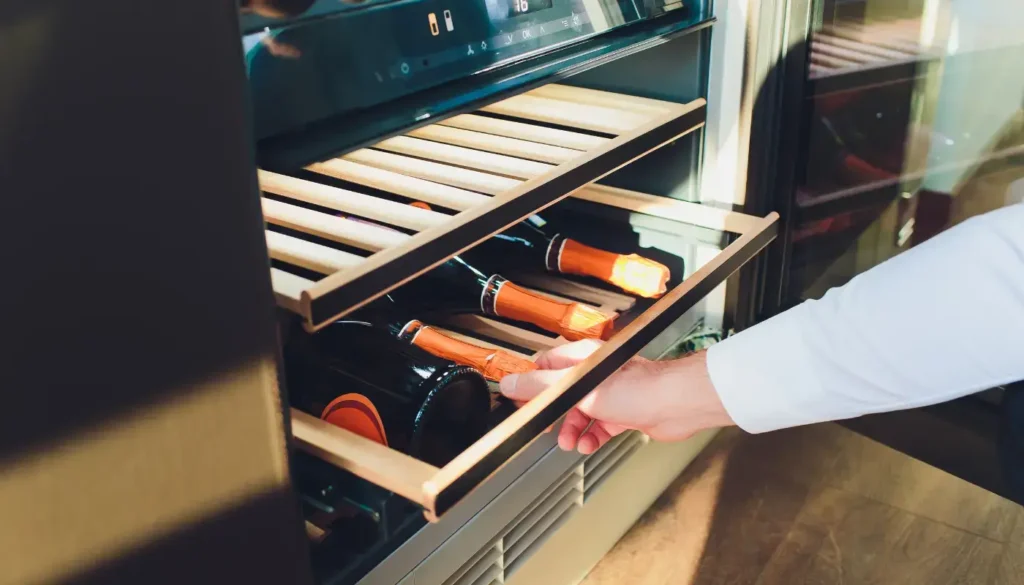
If you buy wine by the case, keep bottles for more than a few months or simply don’t have a cool spot at home, a wine fridge is a great investment. It keeps your wine at a steady temperature, away from light, and many models have UV-protective glass doors.
Which wine fridge should you buy?
The right wine fridge depends on how many bottles you keep and where you’ll put it. Here’s what to look for:
- Real capacity: the number of bottles is based on slim Bordeaux-style bottles, so you’ll fit fewer wider bottles, like Burgundy or Champagne
- Compressor or thermoelectric: thermoelectric models are quieter and cheaper, but struggle to stay cool in a warm room
- A UV-protective door: to keep light away from your bottles
- One or two zones: a dual-zone fridge keeps reds and whites at different temperatures, ready to serve
- Freestanding or built-in: freestanding models need space around them to breathe, so only fit an under-counter model under a worktop
Small countertop wine fridges
Perfect for a kitchen worktop or a small flat, they hold a handful of bottles ready to open, rather than a collection to age. Good options include a 6-bottle, an 8-bottle and a 12-bottle model.
Medium wine fridges
A good compromise if you keep a couple of cases at home, with room for everyday bottles and a few special ones. An 18-bottle or a 20-bottle fridge is plenty for most homes.
Under-counter wine fridges
These slot under a kitchen worktop, like a dishwasher, and most can also stand on their own. Choose a single-zone or a dual-zone model, depending on whether you drink mostly one colour or both.
Large wine fridges
For a serious collection, these work like a small cellar, holding up to 179 bottles for long-term ageing. A single-zone fridge is ideal for ageing, while a dual-zone one also keeps a few bottles ready to serve.
Which wine rack should you buy?
Stackable wine racks
A stackable wine rack is the cheapest and easiest way to start: it keeps bottles on their side and grows with your collection.
Wall-mounted wine racks
A wall-mounted rack saves floor space and shows off your bottles, but keep it away from radiators, windows and the oven.
Wine rack cabinets
A wine cabinet doubles as a home bar, with space for bottles and glasses. A fluted wooden cabinet can become a real feature in a dining room, and some, like this one, even fit a small wine fridge. Keep it in a cool room, as it doesn’t control the temperature.
How long can you keep wine?
Most wine is made to be enjoyed within a year or two of buying it, so there’s no need to keep everyday bottles for years. Only a small number of wines really improve with age, such as top Bordeaux and Burgundy, good Riesling and Vintage Port.
If you’re not sure, it’s usually better to open a bottle a little too early than too late. Once it’s open, the clock starts ticking, as most opened wines only keep for a few days.

How can you tell if stored wine has gone bad?
Before opening a bottle, check for a few warning signs: a cork that’s pushing out of the neck, wine that has leaked around the cork, or a white wine that has turned deep gold or brown. These usually mean the bottle got too warm or let in air. Once opened, a flat, oxidised smell, a bit like Sherry, or a vinegary one is a sign the wine is past its best, one of the most common wine faults.
FAQ
Should red and white wine be stored at different temperatures?
No, all wines, red, white, rosé or sparkling, are best stored at the same cool temperature, around 13°C. Only the serving temperature changes, so chill or warm each bottle just before opening.
How long does unopened wine last?
Most everyday wines are best within one to two years. Fine wines made for ageing can last much longer if they’re stored in the right conditions.
Should you store Champagne lying down?
For long-term storage, yes, like any bottle with a natural cork. For a few weeks before a celebration, standing it up is fine.
Can you store wine in the garage?
It’s not ideal, as most garages get too hot in summer and too cold in winter. If yours stays cool and stable all year, it can work for short-term storage.